KATHMANDU — Air quality in Kathmandu has reached concerning levels, with the Air Quality Index (AQI) recorded at 168 as of the evening of February 25, 2026. This reading places the city's air quality firmly in the "Unhealthy" category, primarily driven by high concentrations of fine particulate matter (PM2.5) reaching 80 µg/m³.
Health Advisory
At an AQI level of 168, the general public may begin to experience adverse health effects, with sensitive groups—such as children, the elderly, and individuals with respiratory or heart conditions—at risk of more serious health impacts. Health experts advise the general public to limit prolonged outdoor exertion, while those in sensitive groups are encouraged to avoid such activities entirely.
Understanding the Air Quality Index (AQI)
The AQI is a standardized tool used to communicate the health risks of air pollution. Understanding these categories can help residents make informed decisions about their health and outdoor activities.
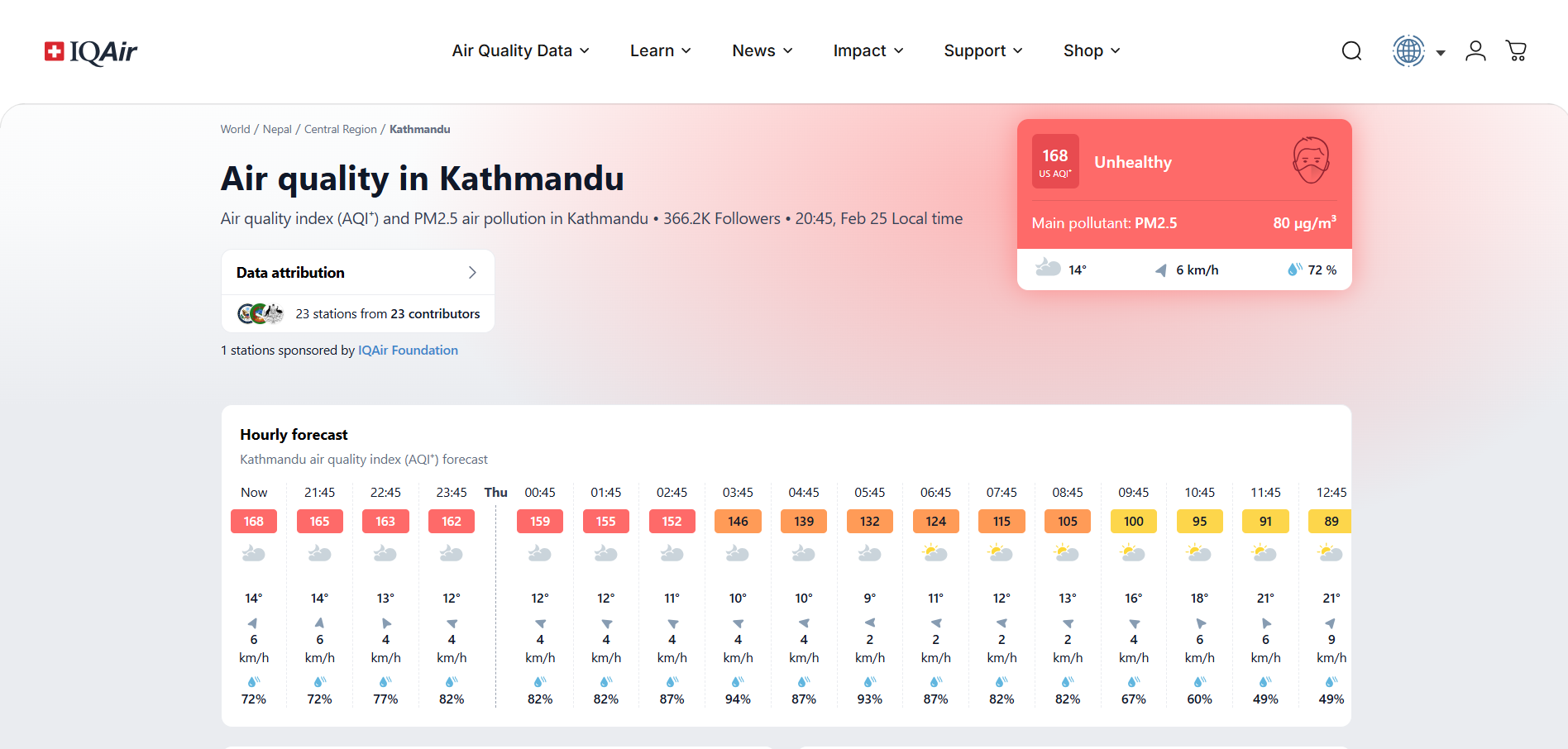
Fig: Air quality index of Kathmandu by IQAir
| AQI Range |
Status |
Health Implications |
| 0 – 50 |
Good |
Air quality is satisfactory; poses little or no risk. |
| 51 – 100 |
Moderate |
Acceptable air quality; minor concerns for unusually sensitive individuals. |
| 101 – 150 |
Unhealthy for Sensitive Groups |
Sensitive groups may experience health effects; general public unlikely to be affected. |
| 151 – 200 |
Unhealthy |
Everyone may begin to experience health effects; sensitive groups may suffer more seriously. |
| 201 – 300 |
Very Unhealthy |
Health alert; serious health effects likely for everyone. |
| 301+ |
Hazardous |
Emergency conditions; entire population likely to be affected. |
Residents are urged to monitor local air quality updates and take necessary precautions, such as reducing time spent outdoors and wearing protective masks when necessary, especially during periods of higher pollution.